टेनिस में स्कोरिंग इतनी अलग क्यों होती है? जानिए इसके पीछे का रोचक इतिहास


टेनिस में स्कोरिंग इतनी अलग क्यों होती है? जानिए इसके पीछे का रोचक इतिहास

टेनिस दुनिया के सबसे लोकप्रिय खेलों में से एक है, लेकिन इसके स्कोरिंग सिस्टम (15, 30, 40) ने हमेशा नए दर्शकों को हैरान किया है। क्रिकेट या फुटबॉल की तरह यहाँ 1, 2, 3 नहीं, बल्कि एक अनोखा पैटर्न चलता है। क्या आपने कभी सोचा है कि Tennis Scores इतने पेचीदा क्यों होते हैं? आइए, इस खेल के पीछे के उस दिलचस्प इतिहास को जानते हैं जो सदियों पुराना है।

टेनिस स्कोरिंग का रहस्य: 15, 30 और 40 ही क्यों?

टेनिस के स्कोरिंग सिस्टम की उत्पत्ति के पीछे कोई एक ठोस प्रमाण तो नहीं है, लेकिन इतिहासकार दो मुख्य सिद्धांतों को सबसे ज्यादा सही मानते हैं।

1. घड़ी का सिद्धांत (The Clock Theory)

माना जाता है कि मध्यकाल में फ्रांस में जब टेनिस की शुरुआत हुई, तब स्कोर रखने के लिए घड़ी के डायल (Clock Face) का उपयोग किया जाता था। एक गेम जीतने के लिए खिलाड़ी को 60 अंक तक पहुँचना होता था। इसे चार भागों में बांटा गया था: 15, 30, 45 और 60।

समय के साथ ’45’ को छोटा करके ’40’ कर दिया गया। इसके पीछे तर्क यह है कि अंपायर को ‘फोर्टी-फाइव’ बोलने के बजाय ‘फोर्टी’ बोलना ज्यादा आसान लगता था। जब खिलाड़ी 40-40 पर होते थे, तो इसे ‘ड्यूस’ कहा जाता था, और गेम जीतने के लिए खिलाड़ी को दो लगातार अंक जीतने होते थे।

2. फ्रेंच जुए का कनेक्शन

एक अन्य प्रचलित सिद्धांत के अनुसार, पुराने समय में फ्रांस में ‘ज्यू डी पॉम’ (Jeu de Paume) नामक खेल खेला जाता था, जो टेनिस का पूर्वज है। उस समय प्रति अंक पर दांव लगाया जाता था। सिक्कों की वैल्यू के आधार पर 15 ‘डेनिएर’ (Deniers) का दांव होता था, जिससे 15, 30 और 60 का क्रम बना।

‘लव’ (Love) का मतलब जीरो क्यों?

टेनिस में जब किसी खिलाड़ी का स्कोर जीरो होता है, तो उसे ‘जीरो’ नहीं बल्कि ‘लव’ (Love) कहा जाता है। इसके पीछे दो रोचक धारणाएं हैं:

  • L’oeuf (अंडा): फ्रांसीसी शब्द ‘ल’उफ’ (L’oeuf) का अर्थ है अंडा। अंडे का आकार जीरो जैसा होता है। अंग्रेजों ने इस शब्द को सुना और इसका उच्चारण बदलते-बदलते ‘लव’ कर दिया।
  • खेल के प्रति प्रेम: एक अन्य मत यह है कि यदि खिलाड़ी का स्कोर जीरो है, तब भी वह केवल खेल के प्रति अपने प्रेम (Love for the game) के लिए खेल रहा है।

‘ड्यूस’ (Deuce) और ‘एडवांटेज’ (Advantage) क्या है?

जब दोनों खिलाड़ियों के अंक 40-40 हो जाते हैं, तो इसे ‘ड्यूस’ कहा जाता है। यह शब्द फ्रांसीसी शब्द ‘Deux du jeu’ से आया है, जिसका अर्थ है ‘खेल के दो अंक बाकी’। यहाँ से गेम जीतने के लिए किसी एक खिलाड़ी को लगातार दो अंक जीतने होते हैं। पहला अंक जीतने पर ‘Advantage’ मिलता है और अगला अंक जीतने पर वह गेम जीत जाता है।

निष्कर्ष (Conclusion)

टेनिस की स्कोरिंग प्रणाली भले ही आज के दौर में थोड़ी जटिल लगे, लेकिन यह इस खेल की सदियों पुरानी परंपरा और गरिमा को संजोए हुए है। घड़ी के कांटों से लेकर फ्रांसीसी सिक्कों तक, Tennis Scores का इतिहास इस खेल को अन्य सभी खेलों से अलग और क्लासिक बनाता है। अगली बार जब आप रोजर फेडरर या राफेल नडाल का मैच देखें, तो याद रखिएगा कि आप केवल एक मैच नहीं, बल्कि इतिहास के एक रस्मो-रिवाज़ को देख रहे हैं।


अक्सर पूछे जाने वाले प्रश्न (FAQs)

1. टेनिस में 45 के बजाय 40 का उपयोग क्यों किया जाता है?

माना जाता है कि अंपायरों की सुविधा के लिए ‘फोर्टी-फाइव’ को छोटा करके ‘फोर्टी’ कर दिया गया, क्योंकि यह पुकारने में छोटा और स्पष्ट था।

2. ‘ड्यूस’ होने पर क्या होता है?

ड्यूस (40-40) होने पर खिलाड़ी को गेम जीतने के लिए लगातार दो अंक लेने होते हैं—पहला ‘एडवांटेज’ और दूसरा ‘गेम पॉइंट’।

3. क्या टेनिस के नियम हमेशा से ऐसे ही थे?

नहीं, आधुनिक टेनिस के नियम 1870 के दशक में वाल्टर क्लॉप्टन विंगफील्ड द्वारा औपचारिक रूप दिए गए थे, लेकिन स्कोरिंग सिस्टम सदियों पुराने फ्रांसीसी खेलों से प्रेरित है।

4. सेट और मैच में क्या अंतर है?

अंकों से ‘गेम’ बनता है, गेम्स के समूह से ‘सेट’ बनता है और सेट जीतने से पूरा ‘मैच’ जीता जाता है।

Do you know why tennis has such a strange scoring system. I do!

Tennis Scoring System History Explained: Why Love, 15, 30, 40? | BBC Sport #Shorts


Tennis Scoring System History Explained: Why Love, 15, 30, 40?

Tennis is one of the most popular individual sports in India, with legends like Leander Paes, Mahesh Bhupathi, and Sania Mirza inspiring generations. However, for a newcomer watching the Australian Open or Wimbledon, the tennis scores can seem baffling. Why do we count in 15s? Why is 40 the third point? And why on earth is zero called “Love”?

Inspired by the insights from BBC Sport #Shorts, let’s dive into the quirky and historic origins of the tennis scoring system.

The Mystery of 15, 30, and 40

The most common theory regarding the 15, 30, and 40 sequence dates back to medieval France. It is widely believed that the score was originally tracked using a clock face.

The minute hand would be moved a quarter turn for every point scored: 15, 30, and 45. The game would end when the hand reached 60. But wait—why do we say 40 today instead of 45?

Historians suggest that “45” was eventually shortened to “40” simply because it was easier and quicker to call out during a fast-paced match. In the heat of a rally, two syllables are better than three!

Why is Zero Called “Love”?

The term “Love” in tennis has nothing to do with romance. There are two primary theories behind this terminology:

  • L’oeuf (The Egg): This is the most widely accepted theory. It comes from the French word for egg, l’oeuf, because an egg resembles the shape of a zero. Over time, English speakers mispronounced it as “Love.”
  • Playing for Love: Another theory suggests it comes from the phrase “to play for love,” meaning playing for the sake of the game rather than for money or stakes, signifying a score of zero.

The Concept of Deuce and Advantage

If the scoring was purely clock-based, a tie at 45 (or 40) would be problematic. This is where Deuce comes in. The word originates from the French “à deux le jeu,” meaning the game is “to two”—meaning a player must win two consecutive points to clinch the game.

In the Indian tennis circuit, from local club tournaments to national levels, the “Ad-court” and “Deuce-court” are fundamental terms every player learns on day one.

The Hand-Ball Theory

An alternative theory suggests that the scoring comes from a game called Jeu de Paume (the precursor to modern tennis). Players would move forward 15 feet, then another 15 feet (30), and finally 10 feet (40) to avoid being too close to the net. While less popular than the clock theory, it highlights how much the sport has evolved from its palm-striking origins.

Conclusion

The tennis scoring system is a beautiful blend of French tradition and centuries of evolution. While 15, 30, and 40 might seem illogical at first glance compared to 1, 2, and 3, they represent the rich heritage of the “Gentleman’s Game.” Whether you are playing at the RK Khanna Stadium in Delhi or watching a Grand Slam on your TV in Mumbai, understanding these tennis scores connects you to a history that spans over 500 years.

Frequently Asked Questions (FAQs)

1. Why is 40 used instead of 45 in tennis?

It is believed that “40” was adopted as a shorthand for “45” because it was easier for umpires to shout out quickly during matches.

2. What does “Deuce” mean in tennis?

Deuce occurs when the score is tied at 40-40. A player must then win two consecutive points (Advantage and then Game) to win the game.

3. What is a “Golden Set” in tennis?

A Golden Set is when a player wins every single point in a set (24 points to 0) without losing a single point to the opponent.

4. Do all tennis matches use the same scoring?

While the internal game scoring (15, 30, 40) is standard, the number of sets varies—men usually play best-of-five in Grand Slams, while women and ATP/WTA tour events play best-of-three.

SUBSCRIBE so you never miss out on our best videos
➡️➡️

=============

Find us here:

BBC Sport:
Facebook:
Twitter:
Instagram:
TikTok:

#bbcsport #tennis #wimbledon

Where does the tennis scoring system come from? | BBC Sport #shorts

How Tennis Scoring Works: Points, Games, and Sets Explained for Beginners


How Tennis Scoring Works: Points, Games, and Sets Explained for Beginners

Tennis is one of the most popular individual sports in India, with stars like Sania Mirza, Leander Paes, and Rohan Bopanna making the country proud on the global stage. However, for a beginner, looking at the tennis scores on a TV screen can be confusing. Why does the score go from 15 to 30, and what on earth is a ‘Love’ score?

In this guide, we break down the fundamental structure of tennis scoring so you can follow the next Grand Slam or local tournament with ease.

The Three Tiers of Tennis Scoring

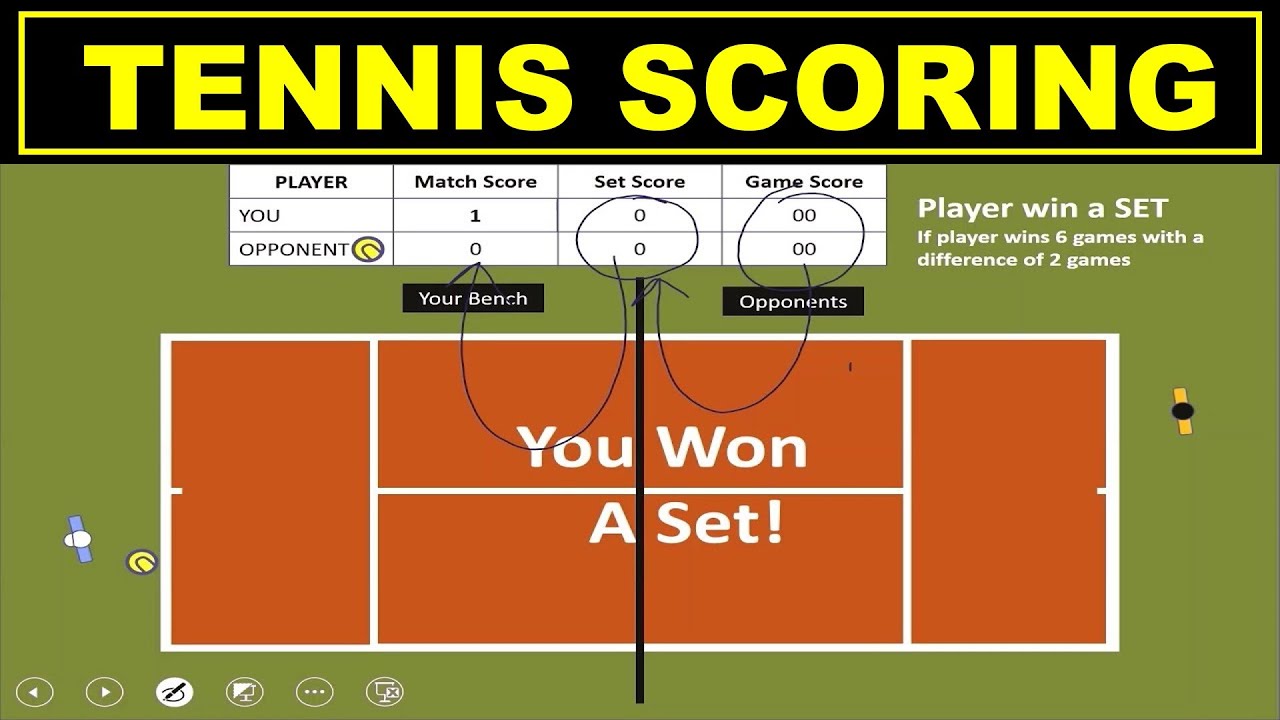
Tennis scoring is hierarchical. To win a match, you must win Sets; to win a set, you must win Games; and to win a game, you must win Points.

1. Scoring Points within a Game

Unlike most sports where points are counted as 1, 2, 3, and 4, tennis uses a unique numerical system:

  • 0 Points = “Love”
  • 1 Point = 15
  • 2 Points = 30
  • 3 Points = 40
  • 4 Points = Game (Over)

Deuce and Advantage: If both players reach 40-40, it is called a “Deuce.” To win the game from a deuce, a player must win two consecutive points. The first point won is called “Advantage.” If that player wins the next point, they win the game. If they lose it, the score returns to Deuce.

2. Scoring Games within a Set

To win a set, a player must typically win at least six games. However, there is a catch: you must win by a margin of at least two games (e.g., 6-4).

If the score reaches 5-5, the set continues. If it reaches 6-6, a Tie-breaker is played. In a tie-breaker, points are counted as 1, 2, 3, etc. The first person to reach 7 points (with a 2-point lead) wins the tie-breaker and the set (7-6).

3. Scoring Sets to Win the Match

In most professional tournaments (including the ATP and WTA tours), matches are Best of Three Sets. This means the first person to win two sets wins the match. In Men’s Singles at Grand Slams (like Wimbledon or the Australian Open), matches are Best of Five Sets, meaning the first to win three sets wins.

Common Tennis Score Terms in India

If you are watching tennis scores on platforms like Hotstar or SonyLIV, you might see these terms:

  • Break Point: When the player receiving the serve is one point away from winning the game.
  • Hold: When the player serving wins the game.
  • Straight Sets: When a player wins the match without losing a single set (e.g., 2-0 or 3-0).

Conclusion

While the terminology of “Love,” “Deuce,” and “15-30-40” might seem strange at first, it becomes second nature once you start watching or playing the game. Tennis scoring ensures that the match remains competitive until the very last point. Whether you are heading to the local courts in Delhi or Mumbai, or just tracking tennis scores online, you are now ready to follow the action like a pro!

Frequently Asked Questions (FAQs)

1. Why is zero called “Love” in tennis?

The most popular theory is that it comes from the French word “l’oeuf,” which means “the egg,” representing the shape of a zero. Over time, it was anglicized to “Love.”

2. What is a ‘Golden Set’ in tennis?

A Golden Set is when a player wins every single point in a set (24 points to 0), meaning their opponent did not score a single 15, 30, or 40. This is extremely rare in professional tennis.

3. What happens if a match is interrupted by rain?

In most tournaments, the match stops and resumes from the exact same point and game score once the weather clears or the match is moved to an indoor court.

4. Do doubles matches have different scoring?

The basics are the same, but many doubles tournaments use a “No-Ad” (No Advantage) rule where a sudden-death point is played at Deuce, and a 10-point “Match Tie-break” is played instead of a third set.

I have explained the basic scoring and also included some of the complex situations that arrives while playing tennis. Enjoy! If you have any question leave a comment below , I’ll answer asap! CHEERS!

00:00 Introduction
0:20 Singles vs Doubles
0:42 Scoring in tennis
1:00 Game, Set & Match
2:21 What happens after every Game
3:56 Deuce in Tennis (Advantage in tennis)
6:12 Winning a set
7:10 Special Cases
8:07 Tie Break
8:38 Doubles scoring

—————————————————————-
RULES OF SPORTS
—————————————————————-
Rules of Pickleball :
Rules of Baseball :
Rules of Golf :
Rules of Tennis :
Rules of American Football :
Rules of Basketball :
Rules of Cricket :
Rules of Football/Soccer :
Rules of Volleyball :
Rules of UFC:

—————————————————————-
SCORING AND TACTICS OF SPORTS
—————————————————————-
Scoring in Tennis :
Pickleball Doubles Scoring :
American Football Strategy & Tactics :

Comment below and please provide your feedback so I can improve and serve our humanity better 🙂 Cheers!

Just want to let you know that you are
AMAZING! FANTSTIC! AWESOME!